World Record cardstacker Bryan Berg has recreated the Bejing Olympic Village using 140,000 playing cards.
Uploaded by diagonaluk on Aug 14, 2008
Wednesday, August 10, 2011

Blood-red lake mystery is getting a lot of attention
"A West Texas lake that is almost completely dried up has left a small mystery, a pool of water that's so red it looks like blood" ~ kxan on Aug 3, 2011
Profile of man's face in Cloud in Nashville TN
"This is picture I took in Nashville of a Storm System, which had clouds that morphed into a Wonderful profile of a bearded man!" ~ InfillNashville @ Aug 2011


Monday, July 18, 2011
Love forever, Vonnie - 53-Year-Old Love Letter Delivered To University
Love Letter Arrives 53 Years Late Man receives letter postmarked Feb. 20, 1958, signed, "Love forever, Vonnie."
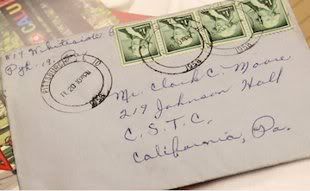
53-year-old love letter finally on way to intended recipient
Since a love letter was written to Clark C. Moore 53 years ago, he has married twice, fathered 21 children, retired as a teacher, converted to Islam and become a Muslim cleric.
In fact, the letter--addressed to Moore when he was a student at Pennsylvania's California University--should now be addressed to Muhammad Siddeeq, as he changed his name years ago when he converted to Islam, the Pittsburg Tribune-Review's Jason Cato writes.
A university mail worker found the opened love letter only last week. It was signed by "Vonnie" and said "I still miss you as much as ever and love you a thousand times more," according to Reuters. Vonnie asked why the object of her affection hadn't called her before he went back to college, but signed the note "Love Forever." National news outlets publicized the discovery, and a Pittsburgh friend recognized Siddeeq's former name and contacted him, according to the Observer-Reporter.
The 74-year-old now lives in Indianapolis and is waiting with mixed emotions for the letter to arrive in his mailbox.
"I'm curious, but I'm not sure I'd put it under the category of 'looking forward to it,'" he told the Tribune-Review.
He and Vonnie married later that year, in 1958, and had four children before divorcing. Vonnie, reached by the paper, said she was upset the letter had been released and did not want her last name known. The couple no longer speak.
Siddeeq told the Observer-Reporter that the romantic piece of mail is "just a testament of the sincerity, interest and innocence of that time."

53-year-old love letter finally on way to intended recipient
Since a love letter was written to Clark C. Moore 53 years ago, he has married twice, fathered 21 children, retired as a teacher, converted to Islam and become a Muslim cleric.
In fact, the letter--addressed to Moore when he was a student at Pennsylvania's California University--should now be addressed to Muhammad Siddeeq, as he changed his name years ago when he converted to Islam, the Pittsburg Tribune-Review's Jason Cato writes.
A university mail worker found the opened love letter only last week. It was signed by "Vonnie" and said "I still miss you as much as ever and love you a thousand times more," according to Reuters. Vonnie asked why the object of her affection hadn't called her before he went back to college, but signed the note "Love Forever." National news outlets publicized the discovery, and a Pittsburgh friend recognized Siddeeq's former name and contacted him, according to the Observer-Reporter.
The 74-year-old now lives in Indianapolis and is waiting with mixed emotions for the letter to arrive in his mailbox.
"I'm curious, but I'm not sure I'd put it under the category of 'looking forward to it,'" he told the Tribune-Review.
He and Vonnie married later that year, in 1958, and had four children before divorcing. Vonnie, reached by the paper, said she was upset the letter had been released and did not want her last name known. The couple no longer speak.
Siddeeq told the Observer-Reporter that the romantic piece of mail is "just a testament of the sincerity, interest and innocence of that time."
Tuesday, July 12, 2011
A Lost World? Atlantis-Like Landscape Discovered
By Wynne Parry
LiveScience.com – Mon, Jul 11, 2011
Buried deep beneath the sediment of the North Atlantic Ocean lies an ancient, lost landscape with furrows cut by rivers and peaks that once belonged to mountains. Geologists recently discovered this roughly 56-million-year-old landscape using data gathered for oil companies.
"It looks for all the world like a map of a bit of a country onshore," said Nicky White, the senior researcher. "It is like an ancient fossil landscape preserved 2 kilometers (1.2 miles) beneath the seabed."
So far, the data have revealed a landscape about 3,861 square miles (10,000 square km) west of the Orkney-Shetland Islands that stretched above sea level by almost as much as 0.6 miles (1 km). White and colleagues suspect it is part of a larger region that merged with what is now Scotland and may have extended toward Norway in a hot, prehuman world.
History beneath the seafloor
The discovery emerged from data collected by a seismic contracting company using an advanced echo-sounding technique. High pressured air is released from metal cylinders, producing sound waves that travel to the ocean floor and beneath it, through layers of sediment. Every time these sound waves encounter a change in the material through which they are traveling, say, from mudstone to sandstone, an echo bounces back. Microphones trailing behind the ship on cables record these echoes, and the information they contain can be used to construct three-dimensional images of the sedimentary rock below, explained White, a geologist at the University of Cambridge in Britain.
The team, led by Ross Hartley, a graduate student at the University of Cambridge, found a wrinkly layer 1.2 miles (2 km) beneath the seafloor — evidence of the buried landscape, reminiscent of the mythical lost Atlantis.
The researchers traced eight major rivers, and core samples, taken from the rock beneath the ocean floor, revealed pollen and coal, evidence of land-dwelling life. But above and below these deposits, they found evidence of a marine environment, including tiny fossils, indicating the land rose above the sea and then subsided — "like a terrestrial sandwich with marine bread," White said.
The burning scientific question, according to White, is what made this landscape rise up, then subside within 2.5 million years? "From a geological perspective, that is a very short period of time," he said.
The study appear on July 10 2011 in the journal Nature Geoscience.
LiveScience.com – Mon, Jul 11, 2011
Buried deep beneath the sediment of the North Atlantic Ocean lies an ancient, lost landscape with furrows cut by rivers and peaks that once belonged to mountains. Geologists recently discovered this roughly 56-million-year-old landscape using data gathered for oil companies.
"It looks for all the world like a map of a bit of a country onshore," said Nicky White, the senior researcher. "It is like an ancient fossil landscape preserved 2 kilometers (1.2 miles) beneath the seabed."
So far, the data have revealed a landscape about 3,861 square miles (10,000 square km) west of the Orkney-Shetland Islands that stretched above sea level by almost as much as 0.6 miles (1 km). White and colleagues suspect it is part of a larger region that merged with what is now Scotland and may have extended toward Norway in a hot, prehuman world.
History beneath the seafloor
The discovery emerged from data collected by a seismic contracting company using an advanced echo-sounding technique. High pressured air is released from metal cylinders, producing sound waves that travel to the ocean floor and beneath it, through layers of sediment. Every time these sound waves encounter a change in the material through which they are traveling, say, from mudstone to sandstone, an echo bounces back. Microphones trailing behind the ship on cables record these echoes, and the information they contain can be used to construct three-dimensional images of the sedimentary rock below, explained White, a geologist at the University of Cambridge in Britain.
The team, led by Ross Hartley, a graduate student at the University of Cambridge, found a wrinkly layer 1.2 miles (2 km) beneath the seafloor — evidence of the buried landscape, reminiscent of the mythical lost Atlantis.
The researchers traced eight major rivers, and core samples, taken from the rock beneath the ocean floor, revealed pollen and coal, evidence of land-dwelling life. But above and below these deposits, they found evidence of a marine environment, including tiny fossils, indicating the land rose above the sea and then subsided — "like a terrestrial sandwich with marine bread," White said.
The burning scientific question, according to White, is what made this landscape rise up, then subside within 2.5 million years? "From a geological perspective, that is a very short period of time," he said.
The study appear on July 10 2011 in the journal Nature Geoscience.
Owl leaves perfect imprint on window

An owl was left in a flap after crashing into a window, leaving a near perfect print of itself on the glass.
Sally Arnold returned home to Kendal, Cumbria, and found the huge imprint complete with eyes, beak and feathers on her bedroom window.
She said: "Our first concern was for the welfare of what we suspected was an owl and we opened up the window to check if it was still around.
"Fortunately, there was no sign of the bird and we can only assume that it had flown away probably suffering from a headache."
The silhouette was left by the bird's "powder down" - a substance protecting growing feathers.
Experts from the Royal Society for the Protection of Birds (RSPB) confirmed the bird was most likely a tawny owl because of its size and shape and the fact that they appear in gardens more regularly than others.
Val Osborne, head of the RSPB's wildlife inquiries team, said: "We don't very often see an imprint of a bird that's flown into a window that's this clear and where it's pretty obvious exactly what kind of birds it is.
"This would have been very uncomfortable for the bird but thankfully it looks like it survived as Mr and Mrs Arnold couldn't find it anywhere close by.
"Sadly, many birds aren't so lucky."
By Press Association , 12/7/2011
Thursday, July 7, 2011
Subscribe to:
Posts (Atom)